Tuesday, April 16, 2013

The Bridge Is Smoking, But It Hasn't Yet Been Burned.


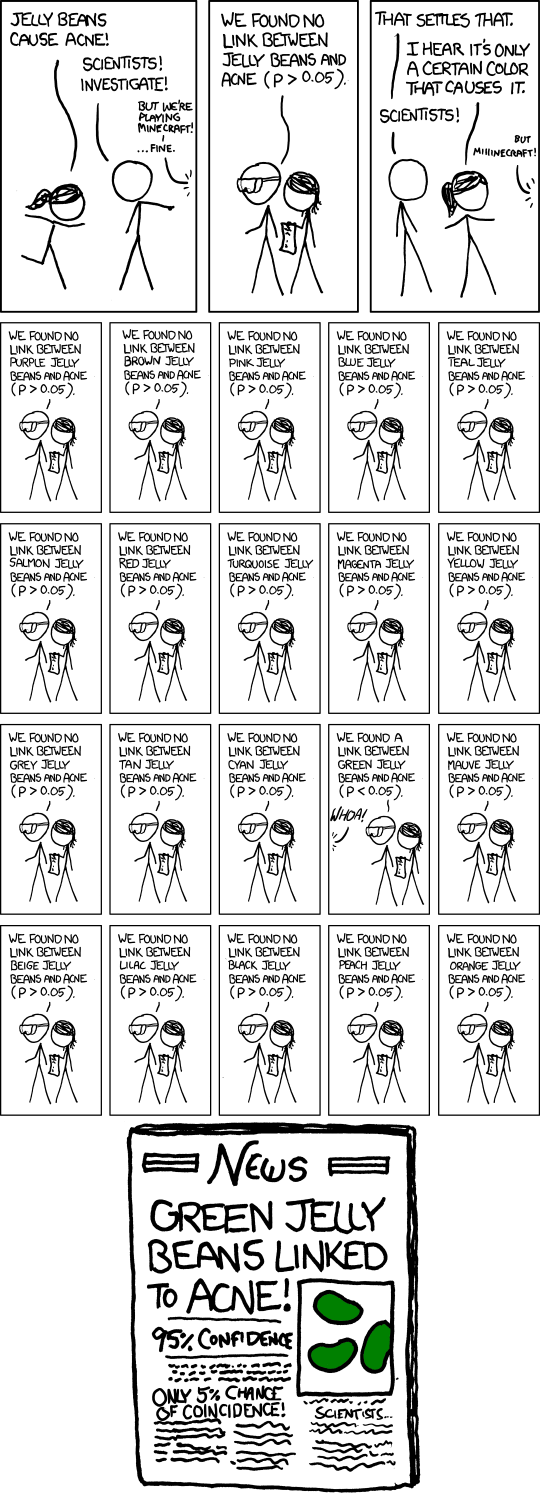
After showing this comic to my wife, I've realized I should explain why it is funny.  The comic illustrates a common statistical error and how the media portray very dismal results.  P Value is a measure of how sure you are that a particular result isn't just chance.  So if you test 20 different colors of jelly beans, then each color is only 5% of your accumulated results.  A 5% chance of coincidence on 5% of the results is 100% chance of coincidence.
Permanent link to this comic: http://xkcd.com/882/
 (If you aren't smiling, hold your mouse over the image for an explanation)

Being a Massage Therapist and a science enthusiast is a very difficult position.  It isn't inherently contradictory, as there is nothing intrinsic to massage that flies in the face of science; rather it is tradition and history that drives a wedge between the two fields.  And if this discussion on LinkedIn is any indicator, that wedge is large, heavy, and very hard to shift.  For those who can't see this discussion, here is what it looks like:


The end result of the discussion, thus far, is some feel you can say nothing at all about massage scientifically, some feel that science is just another religion, some feel that they have quantum-healing-energy-superpowers, and some feel that we should, in fact, look at the research before we tell a patient what massage can and cannot do.

In other words, there is no real consensus.  This answer would be obvious in any other field; LMTs are unsure whether evidence is important in evaluating what is and isn't fiction.


My position on this is in two parts.

  1.  The first part of me knows that there is no valid reason to avoid looking at the science.  You can say it is difficult, or you can say it is biased, or you can claim that your own personal evidence is better than anything that science can offer.  All of these explanations, when talked out to their logical conclusion fall flat.  
    • I am too busy, it is too hard: If you are offering massage, you have an obligation to understand how it works. Do you have any business ethics?  I would never offer my patients something if I couldn't explain why it is worth spending their hard earned money on.  This is just laziness and apathy.  If you can't understand something, ask someone in the field to explain it.
    • The Big Pharma Conspiracy: You think all scientists and doctors are conspiring to hide the truth and invalidate what would actually heal people?  Okay, then you have to back that assertion up with evidence.  A conspiracy of this magnitude would require complicity of nearly every major university, hospital, medical journal, and researcher.  If that is your perspective on the world, you seem to be living in The Truman Show. For that matter, how do you know the conspiracy theorists learned from weren't a part of a conspiracy to keep you ignorant?  As Christopher Hitchens said, "That which can be asserted without evidence, can be dismissed without evidence."
    • I make my own evidence: If you believe your personal anecdotes are better than all the scientific research, ask yourself if it is:
      • reviewed by peer-experts?
      • checked for human error, effect size, chance of coincidence?
      • evaluated for significance against placebo?
      • replicated by other experts?
      • checked against similar reports?
      • controlled and measured carefully? 
  2. The second part of me knows that a huge amount of this is faith-based. Some people speak about quantum physics, fascia, or consciousness in hushed tones. To them, there will never be enough evidence to overturn their desire to live in a particular version of the universe. One where their thoughts become things, their intentions produce results, and stuffy guys in lab coats are flummoxed by their deeper understanding of the world.
    • Quantum Physics is mysterious, and hard to understand:  For this reason gurus have grabbed on to it, and used it to assert fiction.  A simple look at Wikipedia can offer the explanation for most of these misinterpretations
      • The Observer Effect: ever check your tire pressure with a pressure gauge, and in doing so let out some air?  That drop in air pressure, the one caused by poking the pin inside the valve stem, that is the "mysterious" observer effect.
      • Particles don't follow Newtonian Physics: True, because particles are too small to be effected by those laws, but thoughts, intentions, emotions, and the like are not that small, and neither is anything you will ever experience with your senses.
      • Everything is energy:  Not really, everything is MADE of energetic particles.  For perspective on the difference, ask yourself this: can I breathe under water?  Water is made of Hydrogen and Oxygen, you can breathe hydrogen and oxygen, but you can't breathe water.  This is called the Fallacy of Composition.
    • Fascia is everywhere in the body: It is the container that holds organs, muscles, nerves, and vascular tissues.  This is often misconstrued to mean that fascia does all things.
    • Consciousness is an extremely slippery subject:  How would we measure something from the inside out?  But that doesn't mean that you can say anything you want about it and be right.  Also, we don't have to know everything about something to know something about it.
      • Deepak Chopra said so: This is called the Appeal to Authority.  He is a very intelligent man, but he isn't infallible.  He is only human.  His opinions are often anti-science, and he is always selling something to improve your quantum-spiritual-well-being. 
      • The Law of Attraction:  It's a LAW right?  It sounds sciencey!  Too bad this isn't actual science, but a construct of New Age Philosophy. One which lacks the values of any physical science law, it can not be verified nor falsified. It also ignores a simpler and thus more plausible explanation. 

So what does that leave us with?  Can we leap over this divide and find a space where those of us who want to help others can do so without trying to sell them our philisophical or religious values? Can someone who is deeply entrenched in ancient tradition still reach out to science for explanations without judgement?

The Dalai Lama thinks so. "If science proves some belief of Buddhism wrong, then Buddhism will have to change. In my view, science and Buddhism share a search for the truth and for understanding reality."

Who am I to disagree?

Wednesday, April 10, 2013

Can we talk about Cognitive Dissonance?

Other links regarding bias and dissonance:
The limits of reason
Treacherous Trio: confirmation bias, cognitive dissonance, and motivated reasoning


In a perfect world, one which we all wish to inhabit, humans are rational creatures. To make decisions, we rely on the best evidence from the most accurate sources, and choose the most prudent course of action. When confronted with the fact that something we previously believed was untrue, we throw our hands up and say, "I don't mind being wrong; that is how you learn stuff."


I don't think I have to tell you that we don't live in that world. I posted this image on facebook:


I can never know how many people looked at it, found it challenging, and then quickly found something else to look at.  I do know that it made at least one friend disgusted, uncomfortable, and even angry.  Driving him to question my education, accuse me of evangelizing science, and to ultimately abandon discussing the topic in favor of personal attacks and insults. 

When a little while later the same image appeared on The Scientist and IFLS... The reactions were very similar to what I experienced.  Most people expressed anger and outrage that whatever thing within the diagram they personally believed in was 100% real and anyone questioning it was stupid to do so.

So what is it about an image like this that causes such a visceral reaction? Why is it when people like Paul Ingraham, Alice Sanvito, and Ravensara Travillian bring research and accurate information to the public about massage they are met with personal attacks, insults, and outright derision?

Saveyourself.ca's own Venn Diagram


The answer is cognitive dissonance. Research has shown that "the primary causal agent for misperception is not the presence or absence of correct information but a respondent’s willingness to believe particular kinds of information" and that we are "...responding to information defensively, accepting and seeking out confirming information, while ignoring, discrediting the source of, or arguing against the substance of contrary information (DiMaggio 1997; Kunda 1990; Lodge and Tabor 2000)."

There is no way to turn off this bias, and it is a very strong motivator.  In evolutionary terms, it benefits our survival to feel secure in an orderly universe, and not experience doubt of our beliefs.  Like pain, the uneasy feeling we get when confronted with contradictory evidence is the brain's alarm and defense system.  One part of your brain is telling another part, "You better not go there, it will shake things up too much!"  Also, like pain, you need slow and graded exposure over time to change an existing state.  Old, deeply rooted, or cherished beliefs will not go out without a fight.


To tie this into massage, because this is a massage blog, when you hear any of the following:

Massage removes toxins -- Nope
Your pain is caused by Lactic Acid, massage removes it -- Nope and more Nope
Massage increases blood flow to the muscles -- Nope... No, but it does increase skin circulation
You need to heal your energy -- All kinds of Nope  Two  Three  Four
I'm going to stretch your fascia -- Not likely
Always massage toward the heart -- see Laura Allen link
Don't massage pregnant women in the first trimester -- see Laura Allen link
Don't touch the ankles of pregnant women -- see Laura Allen link
Don't massage cancer patients -- Wrong

More Massage Myths By Laura Allen
3 massage myths you should stop repeating by Sarah Cafiero

Remember that these things are beliefs, not facts.  You may do well to mention, delicately, that the best evidence we have shows exactly the opposite.  Do not, however, expect to be greeted warmly or to change minds.  You can lead a horse to water, but you can't make it drink.  Likewise, you can lead a human to knowledge, but you can't make it think.

One last myth worth mentioning, because it has some tragic consequences.

Vaccines cause autism  -- No -  Nope -  Still No -  And we lied in the first place.

Sunday, April 7, 2013

TED Talks For You, Understand Pain Better (Part 1)

For a massage therapist and massage patients, understanding pain is absolutely essential. Reading books and research papers is not for everyone, and that is what makes TED such a great concept. Here are some quick and interesting videos to help you get a better grasp on the often head-scratching reality of pain.

Pain is an output from the preconscious brain, not an input from the tissues:

The amount of pain is not always related to the amount of damage:

Pain is subjective, personal, and complicated. (and massage works to decrease it):


... and for bonus, here is Radiolab's interesting podcast on understanding pain:

Wednesday, March 27, 2013

Is your massage a placebo? (Part 2)


Some note worthy links:
Seven alternatives to evidence-based medicine (this is satire, folks)
I highly recommend the "Why Science?" series here.


In the first part of this blog, I explained the origin of, and the need to understand, the placebo in medicine.  I left off with this question: how does one know if massage is a placebo or a valid physical treatment?

Before the inclusion of the Scientific Method, it is safe to assume that tradition was the foundation of clinical reasoning.  The handing down of wisdom from master to student was the best paradigm we had. Much of that wisdom was based in faulty models of how disease, health, and the human body function.  This tradition leads to very poor critical thinking, it even has its own recognized logical fallacy: The Appeal to Tradition.

Finding this appeal doesn't require much work when discussing any form of massage or manual therapy.  Modalities almost universally originate from one charismatic master, and are then carried onward by his/her followers with little room for questioning.  This origin story usually has a sequel when the best students of that master become "apologists" for their respective school and begin to make subtle changes to keep the method alive.  Here is one example of many: Chiropractic Medicine

Massage is deeply rooted in this old paradigm, it is a part of nearly every cultural tradition.  In arguing with other massage therapists (something I often find myself doing) one of the first statements they will make is, "Massage has been around for thousands of years."  This is meant as a blanket defense against all criticism; a tactic used to defend many forms of alternative medicine.  It is meant to demand respect without giving an answer to any of the difficult questions.

That line of thought is helpful in one very substantial way, if other CAM therapies use that same appeal they could be used in designing tests for massage.  In fact, acupuncture is often tested right along-side massage. The results are fascinating for these studies, mostly because they often conflict and show a wide variety of results.  The highest level of evidence you can find on acupuncture indicates that is sometimes works better than a "sham" treatment, and even that is contended for good reasons.  Poking people with needles (sometimes with heat or vibration or electricity added) is a very large sensation, which will effect how the brain reports pain. 

It's important to note here that not all placebos are created equally.  As Dr. Harriet Hall put it:
We not only know placebos “work,” we know there is a hierarchy of effectiveness:
  • Placebo surgery works better than placebo injections
  • Placebo injections work better than placebo pills
  • Sham acupuncture treatment works better than a placebo pill
  • Capsules work better than tablets
  • Big pills work better than small
  • The more doses a day, the better
  • The more expensive, the better
  • The color of the pill makes a difference
  • Telling the patient, “This will relieve your pain” works better than saying “This might help.”
Here is the rest of that very enlightening article. 

You'll notice that spending time engaging one on one with a person while physically applying pressure isn't on that list.  Again, how does one fake interpersonal contact?  It has also been shown that patient expectations influence the results.

Massage research is very poorly executed, and very poorly standardized.  Researchers have to define what they mean by "massage" before engaging in a study.  The method of precise measurement of time, amount of pressure, style, direction of force, purposed model, and practitioner expertise must be worked out before the trial even begins.  That is why so many reviews are inconclusive:

"No recommendations for practice can be made at this time because the effectiveness of massage for neck pain remains uncertain."

"It is concluded that too few trials of massage therapy exist for a reliable evaluation of its efficacy."

To further complicate matters this systematic review, recommends "acupuncture massage."

Friday, March 22, 2013

Is your massage a placebo? (Part 1)

http://www.beatricebiologist.com/2013/03/evolution-of-placebo-effect.html
Since day one of being a massage therapist, the single most interesting and wide-spread concept I've run into is the Placebo Effect. When it comes to treating any kind of condition, the idea that my hard work could be irrelevant to the results can be both frustrating and intimidating. Everyone I work with knows of the placebo effect, but few understand it thoroughly, or how it applies to massage.

Lifted from Wikipedia "The word placebo itself originated from the Latin for I shall please.[1] It is in Latin text in the Bible (Psalm 116:9, Vulgate version by Jerome, “Placebo Domino in regione vivorum”, “I shall please the Lord in the land of the living”). Jerome translated as "I will please" (placebo), the Hebrew word "ethalech", "I will walk with" as in "I will be in step with". This word gave its name, placebo, to the Office of the Dead church service. From that, a singer of placebo became associated with someone who falsely claimed a connection to the deceased to get a share of the funeral meal, and hence a flatterer, and so a deceptive act to please.[2]"

Voltaire famously said "The art of medicine consists in amusing the patient while nature cures the disease." and in Voltaire's time (1694-1778), this was very true. Medicine was still mired deeply in Vitalism, The Four Humors, and Folk Medicine. During Voltaire's century people were often killed by their physician with "medicines" that proved poisonous, botched/unnecessary surgeries, and the practice of bloodletting. It is fair to say that science and medicine have evolved since then; but how has it evolved and by what method?

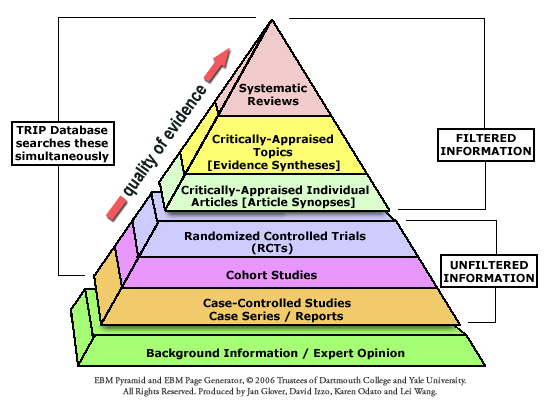
A first step was the introduction of techniques to control against the many confounding factors that obscure results. Every "expert" is a flawed observer; placebo effect, confirmation bias, regression to the mean, belief bias, attentional bias, and a whole host of logical fallacies distort perception. Regardless of education or experience, humans will make observational errors that undermine their search for effective treatments. The more time and money one has spent on a particular area of study, the more likely one is to fall victim to ignoring information which disputes that area. Which is why the opinions of experts are at the bottom of the Evidence Pyramid:


In the book Trick or Treatment: The Undeniable Facts about Alternative Medicine by Edzard Ernst and Simon Singh, we start with the story of Dr. James Lind (1716-1794) who first identified oranges and lemons as a treatment for scurvy, a disease that effected the outcome of many wars by wasting away and killing millions of sailors. Lind designed the first recorded group study to compare six contemporary treatments (Cider, Sulphuric Acid, Vinegar, Sea Water, Medicinal Paste, *consisting of garlic, mustard, radish root, and gun myrrh and citrus fruit) on sailors with scurvy. It's important to note that the fruit was considered "alternative medicine" at the time and was only included by chance. The medical experts of the day would have likely prescribed bloodletting two or three times over before entertaining nutrition as a mode of treatment.

As my readers may well know, scurvy is a deficiency of vitamin C, those given cider got a little better and those given lemons and oranges got significantly better. A key point here is the five other treatments had previously shown promise when tested by themselves. The proponents of these treatments, and of bloodletting, weren't dishonest intentionally; they had fallen victim to the Placebo Effect. Placebos will look dramatic in isolation, but once you line them up in a trial against an effective treatment, their effect seems irrelevant.

This method of taking what experts think, then applying a simple test to weed out bad ideas, is the basis of the scientific method. To further illustrate the point about expert opinion, Dr. Lind didn't even understand what he had done, and waited years to report his findings. He even tried to create and sell a lemon juice concentrate (processed in a way that destroyed its vitamin C content) damaging his own credibility with its ineffectiveness.

So how does all this apply to the type of massage I do? It's not like I am curing diseases. Most trained massage therapists know better than to diagnose or claim to treat any physical condition. We should be "complementary" and not "alternative" when we do our jobs correctly. I work within the spectrum of science-based medicine, not in contrast to it. It is very important to make that distinction. I have, and will always refer patients to physicians when I see something outside of my scope of practice.

That said, when I see any patient, I must address their expectations. One who seeks massage therapy for a specific ailment (e.g. headache, neck or back pain, anxiety, depression) usually desire a specific result. How do I get that result? How do I support the claim that I can have any result at all? I know what they want, I know many different ways to approach that goal, but how do I know which to choose? In any decent massage school, we are taught muscle names, origins, and insertions. We are taught (though many forget) the finer details of anatomy and even a decent amount of pathology and kineseology. *We also get a substantial dose of non-sense... but more on that later.* We can't necessarily take this hard science of what is in the body and gain insight into what ought to work. The classic Hume Is-Ought Problem comes to mind.

To further complicate matters, hundred of "experts" over hundreds of years have claimed to have the magic bullet for pain, and have produced an equal number of modalities to capitalize on their personal panacea. Regardless of the fact that a placebo effect could explain most of their results, very little has been done to substantiate the claims of the many gurus in the field of massage and manual therapy. There are books, videos, articles, trade magazines, web pages, seminars, and even entire physical schools dedicated to teaching the "One True Cure" with thousands of methods. Some are unique, most borrow heavily from each other, and many differ in name only.

Massage has no recognized peer-review system. Often times, massage studies are done with no control group at all. If there is a control group (one receiving no treatment) how do we know the massage technique isn't a placebo? There is no established fake treatment that one can give as a placebo to measure massage against. It is almost guaranteed that anything that one person does with the intention to affect another person is a school of massage. For example, touching isn't required, neither is being in the same room. Some are actually quite specific. Other tell us that we all can heal ourselves.


So what could I do to prove any particular method is more effective than a "sham" treatment?

Is your massage a placebo? (Part 2)

8 Random Things Everyone Should Know About Massage

I try to never miss an entire year on my blog, so here is one post for 2018: a list of concepts I think everyone should know before receivin...