Showing posts with label critical thinking. Show all posts

Monday, October 16, 2017

Rational Prenatal Massage

Prenatal massages are among my favorite massages to give. The absolute gratitude pregnant women express after receiving relief from the increased burden on their bodies reminds me why I wanted to by a massage therapist in the first place. Pregnancy is very taxing; massage provides needed time to recuperate and feel comfortable within your own body again. Prenatal sessions also have the added benefit of treating two humans at once, since it is reasonable to expect that the relaxation felt by the mother is passed via biological signaling (hormonal, biomechanical, etc) to the growing fetus. But, along with every good idea comes a load of really bad ideas, and prenatal massage is no exception. Much to my chagrin, several bad ideas are propagated by educators in my field, the major franchises, and even by the agencies meant to regulate massage.

Massage doesn't cause miscarriage!

If you walk into a major franchise massage chain, and you happen to be in your first trimester, there is a good chance you will be asked to leave. Sure, they'll be happy to take your money when you hit the magical second trimester, but until then it is "no massage for you!" Why? Because of persistent mythology around the effects of massage, and fear of getting sued if you should have a miscarriage. It is suspected that somewhere between 1/3rd and 1/2 of pregnancies end in miscarriage (often without the woman even knowing she was pregnant in the first place), and 80% of those happen in the first trimester. So even though no study has EVER linked massage and miscarriage, and experts suggest moderate exercise and massage may in fact be protective against miscarriage, fear often beats reasoning. As for me, I'm happy to report many women, after rejection from strip-mall massage places, come find me and still get their massage. That is, if they aren't convinced that massage will somehow harm their baby.

Contrary to popular beliefs, there are no magic points on the body that work like a baby eject button. Acupuncture points are silly, inconsistent, and based on pre-scientific ideas. I know that isn't a popular opinion, and frankly, I don't care. Even attempts to directly stimulate such points in overdue (41+ weeks) women ended in disappointment. This has also been repeatedly shown to be true with blinded studies. So much so that Cochrane weighed in on it.

Massage is safe and good (even directly on ankles and feet) for pregnant women.

Evidence of the benefits of massage for pregnant women is actually pretty slim, mainly because it has a certain obviousness to it that prevents researchers from investing time in it. Tiffany Field has made quite a career out of looking at the benefits of massage; I have some ambivalence about her work (especially when it comes to her claims about cortisol) but her research is pretty much the only thing out there right now. Here is a partial list:

"Only the massage therapy group, however, reported reduced anxiety, improved mood, better sleep and less back pain by the last day of the study. In addition, urinary stress hormone levels (norepinephrine) decreased for the massage therapy group and the women had fewer complications during tabor and their infants had fewer postnatal complications (e.g., less prematurity)."
- Pregnant women benefit from massage therapy


  • Massage therapy is the most common alternative therapy recommended during pregnancy.
  • Massage therapy has been demonstrated to be effective during pregnancy. The women reported decreased depression, anxiety, and leg and back pain.
  • Depressed pregnant women given the pregnancy massage experienced fewer prenatal complications.
  • In our study on labor pain, the women receiving massage therapy experienced significantly less pain, and their labors were on average 3 h shorter with less need for medication.
  • The most important finding was the lower incidence of prematurity and low birthweight in the massaged depressed women.
  • Postpartum depression and cortisol levels were decreased in the massaged women. The newborns of the massaged mothers also had lower cortisol levels than the newborns of the control mothers, and performed better on the Brazelton Neonatal Behavioral Assessment habituation, orientation and motor scales. An underlying mechanism we have been exploring is that these effects are mediated by increased vagal activity.
- Pregnancy and labor massage

Don't even think about talking to pregnant women about "toxins."

Despite the fact that there is absolutely no evidence that massage releases "toxins" and 99% of the time, the person making such a claim can't even define what the word toxin means, let alone which toxins they are specifically worried about, this myth is still floating around. Carrying around a tiny growing person is stressful enough without adding imaginary toxins. So I'll just leave this here:

No, 
No,
No,
And also, no.

Sidenote: You probably don't have to lay on your side either.

Further Reading: https://view.joomag.com/massage-fitness-magazine-pilot-april-2015/0817501001417732043?page=15

Tuesday, September 10, 2013

Persistent Pain, Part 2 (Everything Else)

For Acute Trauma, Severe Injury, and Disease... Always see your M.D.


For everything else, what can you do?  In part 1, we covered how the persistent pain starts, and how most of us trouble shoot it until we have exhausted our basic knowledge.  Which can often end with an unsatisfying experience with your typical M.D.

If you've read my previous posts, you'll know I'm not the "Appeal to Nature" type.  Modern Medicine has done many amazing things, but right now it is rubbish for the most typical pains that we all live with: low back pain, neck stiffness, headaches, shoulder pain, and of course foot and ankle pain. These conditions send millions of people to their family doctors, cost billions in healthcare annually and countless people just have to live with it.  So what can be done for them?
 

What's My Alternative: Things that may be worth trying


You don't want to be defined by a cranky ankle.  You've tried everything you knew to do, and your General Practitioner didn't help much.  Now what? For most people: Internet Search. (I'm assuming you don't look for answers at Pubmed)

With a basic search, you've gone from no clue to being confronted with too many possibilities.  Assuming you don't limit yourself to solutions with documented evidence, the sky is the limit.  From the statistics, it looks like most people still want an "expert"  and some kind of "medicine" to treat them, and they don't much care if those treatments are evidence-based.

So, what about Acupuncture?   Here, you may get perfectly practical treatment.  Dry-needling for example, can be useful in changing pain states, and has some evidence to back it up.  Most of the time, however, what is being treated is based on what amounts to a mistake due to poorly-translated Chinese.  Energy and Meridians didn't exist in the original ancient texts and are a construct of early 20th century translational misunderstandings. Which hasn't seemed to stop anyone from claiming it as effective, despite regularly getting "no better than a placebo" reviews by the major medical journals or at best: About 10% better than sham treatments.  You will likely be asked to come in for multiple treatments, and you will not be likely to receive a clear and reasonable explanation for why you hurt.  If you are living with pain and nothing else works, it is worth giving a try, but make sure you go to a well trained professional.  The consequences of a small miscalculation can be life destroying.

How about Herbal Medicine? (supplements, herbs, and nutrition)  Here we have a different kind of pill to take, often expensive and rarely tested properly.  Sometimes Poisonous. It is tempting to imagine that pain could be a symptom of some nutritional problem, or that supplements like Glucosamine could help.  Evidence is mixed here, and far too complicated to address in one blanket statement.  My advise?  If you want nutritional information, go to a dietician; someone with medical training at the college level.  If you want to try herbal stuff, make sure your supplements have some evidence behind them, as most don't and can quickly cost you hundreds of dollars.

Chiropractic?  You want to see different kind of doctor, usually get an xray, but there is no medication to take.  Not all chiropractors are the same.  The treatment you receive here can be practical  such as manual therapy and rehabilitation exercises. But much more often, the treatments are baseless or scientifically disproved; such as applied kinesiology, detoxification, or spinal subluxations. Most chiropractic treatments are focused on the spinal joints supposedly impinging nerves and affecting surrounding tissue.  You may get a back adjustment to fix your ankle (or even your allergies.)  The subluxation of the spine model has been written off by many chiropractic authorities:Here is one.    And another.  The experience, most of the time, is to be asked to come in 3 times a week at first, and keep coming (slowly tapering down to monthly) in some capacity forever.  If you choose to go to the chiropractor, go to several and really listen to what they have to say.  Find one that gives you a clear understanding of what is being treated and how the applied treatments will help. 

Exercise and Yoga?   Generally, these can be both pain creators and pain reducers.  Ignoring the spiritual and energy faith practices of Yoga, I'm an advocate of most movement and exercise regiments to reduce pain.  The evidence, however, is still quite mixed.  As an example of how mixed: exercise (unsupervised) has been shown to decrease future ankle problems, while exercise (supervised) has been shown not to help much. And of course, you'll also get a fair amount of nonsense included with your practical exercise advice.  Back pain, for example, probably has nothing to do with a "Weak Core."  You will likely hear a lot of "no pain, no gain" with some trainers going so far as to claim that the pain holding you back can be cured by toughing through it.  Pain is a warning message, and it is best not ignored completely.  Be sure to find someone you trust not to push you into injury.

I'm excluding Physical Therapy, Occupational Therapy, and other rehabilitation medical professionals here. Seeing one of them requires a referral from your M.D., which would makes this whole section not really apply to you.  I have a lot of respect for PT and OT treatments, although they too can fall short of following the best available evidence and science.  Many of my patients come to me because their insurance didn't cover the amount of PT/OT sessions they needed, or because they didn't know where else to turn after conventional and/or alternative treatment didn't work, but I'd always rather they come to me AND get conventional treatment.

In part 3, I will discuss massage and my own approach. What should you expect if you see me for your persistent ankle (or any other) pain?

Tuesday, August 6, 2013

TED Talks For You, Understand Pain Better (Part 2)

For a massage therapist and massage patients, understanding pain is absolutely essential. Reading books and research papers is not for everyone, and that is what makes TED such a great concept. Here are some quick and interesting videos to help you get a better grasp on the often head-scratching reality of pain.

To understand pain, it helps to understand what is going on inside the brain.  Pain is first and foremost a brain state which can be altered by input from visual, psychological cues:


How one perceives their pain, and whether or not one feels in control of it is directly correlated to how much one suffers.  At the PNMT Colloquium, David Flueke spoke about psychosocial aspects of pain, one point he made was that pain feels threatening to quality of life, but when that pain begins to threaten ones identity it becomes suffering:


Past and present pain states are altered by memory and expectation. The amount of happiness and the intensity of pain that one experiences and remembers can change based on how we interpret and define the story around these experiences.

Tuesday, April 16, 2013

The Bridge Is Smoking, But It Hasn't Yet Been Burned.


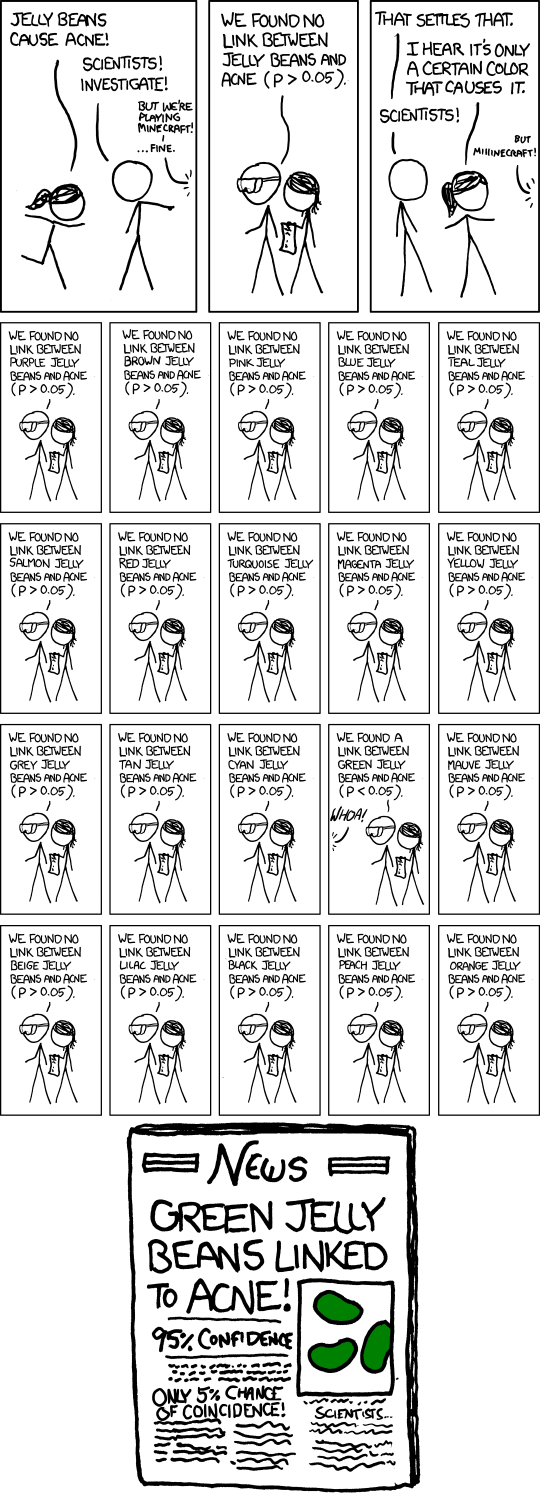
After showing this comic to my wife, I've realized I should explain why it is funny.  The comic illustrates a common statistical error and how the media portray very dismal results.  P Value is a measure of how sure you are that a particular result isn't just chance.  So if you test 20 different colors of jelly beans, then each color is only 5% of your accumulated results.  A 5% chance of coincidence on 5% of the results is 100% chance of coincidence.
Permanent link to this comic: http://xkcd.com/882/
 (If you aren't smiling, hold your mouse over the image for an explanation)

Being a Massage Therapist and a science enthusiast is a very difficult position.  It isn't inherently contradictory, as there is nothing intrinsic to massage that flies in the face of science; rather it is tradition and history that drives a wedge between the two fields.  And if this discussion on LinkedIn is any indicator, that wedge is large, heavy, and very hard to shift.  For those who can't see this discussion, here is what it looks like:


The end result of the discussion, thus far, is some feel you can say nothing at all about massage scientifically, some feel that science is just another religion, some feel that they have quantum-healing-energy-superpowers, and some feel that we should, in fact, look at the research before we tell a patient what massage can and cannot do.

In other words, there is no real consensus.  This answer would be obvious in any other field; LMTs are unsure whether evidence is important in evaluating what is and isn't fiction.


My position on this is in two parts.

  1.  The first part of me knows that there is no valid reason to avoid looking at the science.  You can say it is difficult, or you can say it is biased, or you can claim that your own personal evidence is better than anything that science can offer.  All of these explanations, when talked out to their logical conclusion fall flat.  
    • I am too busy, it is too hard: If you are offering massage, you have an obligation to understand how it works. Do you have any business ethics?  I would never offer my patients something if I couldn't explain why it is worth spending their hard earned money on.  This is just laziness and apathy.  If you can't understand something, ask someone in the field to explain it.
    • The Big Pharma Conspiracy: You think all scientists and doctors are conspiring to hide the truth and invalidate what would actually heal people?  Okay, then you have to back that assertion up with evidence.  A conspiracy of this magnitude would require complicity of nearly every major university, hospital, medical journal, and researcher.  If that is your perspective on the world, you seem to be living in The Truman Show. For that matter, how do you know the conspiracy theorists learned from weren't a part of a conspiracy to keep you ignorant?  As Christopher Hitchens said, "That which can be asserted without evidence, can be dismissed without evidence."
    • I make my own evidence: If you believe your personal anecdotes are better than all the scientific research, ask yourself if it is:
      • reviewed by peer-experts?
      • checked for human error, effect size, chance of coincidence?
      • evaluated for significance against placebo?
      • replicated by other experts?
      • checked against similar reports?
      • controlled and measured carefully? 
  2. The second part of me knows that a huge amount of this is faith-based. Some people speak about quantum physics, fascia, or consciousness in hushed tones. To them, there will never be enough evidence to overturn their desire to live in a particular version of the universe. One where their thoughts become things, their intentions produce results, and stuffy guys in lab coats are flummoxed by their deeper understanding of the world.
    • Quantum Physics is mysterious, and hard to understand:  For this reason gurus have grabbed on to it, and used it to assert fiction.  A simple look at Wikipedia can offer the explanation for most of these misinterpretations
      • The Observer Effect: ever check your tire pressure with a pressure gauge, and in doing so let out some air?  That drop in air pressure, the one caused by poking the pin inside the valve stem, that is the "mysterious" observer effect.
      • Particles don't follow Newtonian Physics: True, because particles are too small to be effected by those laws, but thoughts, intentions, emotions, and the like are not that small, and neither is anything you will ever experience with your senses.
      • Everything is energy:  Not really, everything is MADE of energetic particles.  For perspective on the difference, ask yourself this: can I breathe under water?  Water is made of Hydrogen and Oxygen, you can breathe hydrogen and oxygen, but you can't breathe water.  This is called the Fallacy of Composition.
    • Fascia is everywhere in the body: It is the container that holds organs, muscles, nerves, and vascular tissues.  This is often misconstrued to mean that fascia does all things.
    • Consciousness is an extremely slippery subject:  How would we measure something from the inside out?  But that doesn't mean that you can say anything you want about it and be right.  Also, we don't have to know everything about something to know something about it.
      • Deepak Chopra said so: This is called the Appeal to Authority.  He is a very intelligent man, but he isn't infallible.  He is only human.  His opinions are often anti-science, and he is always selling something to improve your quantum-spiritual-well-being. 
      • The Law of Attraction:  It's a LAW right?  It sounds sciencey!  Too bad this isn't actual science, but a construct of New Age Philosophy. One which lacks the values of any physical science law, it can not be verified nor falsified. It also ignores a simpler and thus more plausible explanation. 

So what does that leave us with?  Can we leap over this divide and find a space where those of us who want to help others can do so without trying to sell them our philisophical or religious values? Can someone who is deeply entrenched in ancient tradition still reach out to science for explanations without judgement?

The Dalai Lama thinks so. "If science proves some belief of Buddhism wrong, then Buddhism will have to change. In my view, science and Buddhism share a search for the truth and for understanding reality."

Who am I to disagree?

8 Random Things Everyone Should Know About Massage

I try to never miss an entire year on my blog, so here is one post for 2018: a list of concepts I think everyone should know before receivin...